Specification writing services: what an outside spec writer does and when to hire one
Specification writing services turn a design into the written part of the contract documents: the project manual that bidders price and the contractor builds from. An outside spec writer researches products, writes Division 01 and the technical sections, and coordinates them with the drawings and the owner's contract terms.
- Topic
- Specifications
- Updated
- Reading time
- 13 min
- Studio
- Morales Arch & Design
In this article
- What specification writing services are
- What a specification writer does
- In-house, freelance or a specification firm
- When to bring a spec writer into the project
- What the service covers: Division 00, Division 01 and technical sections
- What to prepare and how reviews work
- Spec writing mistakes that cost money
- How to judge spec quality and choose a provider
- Specification writing FAQ
What specification writing services are
A specification is the written part of the contract documents. Together with the drawings it forms the project manual, which is used to get bids and then to guide construction. Specification writing services supply that written part: an outside writer, or a small specialist firm, takes the design team's drawings, schedules and product decisions and turns them into instructions the contractor can price and build from.
Specs come in very different sizes. On small projects, and sometimes on medium ones, notes on the drawings can do the job. Most other projects outgrow the sheets, because there is simply not enough room on them, and need a separate project manual that may run to several volumes. Either way, the specification describes the quality of materials, products and workmanship, the services to be provided, and the administrative rules the contractor works under.
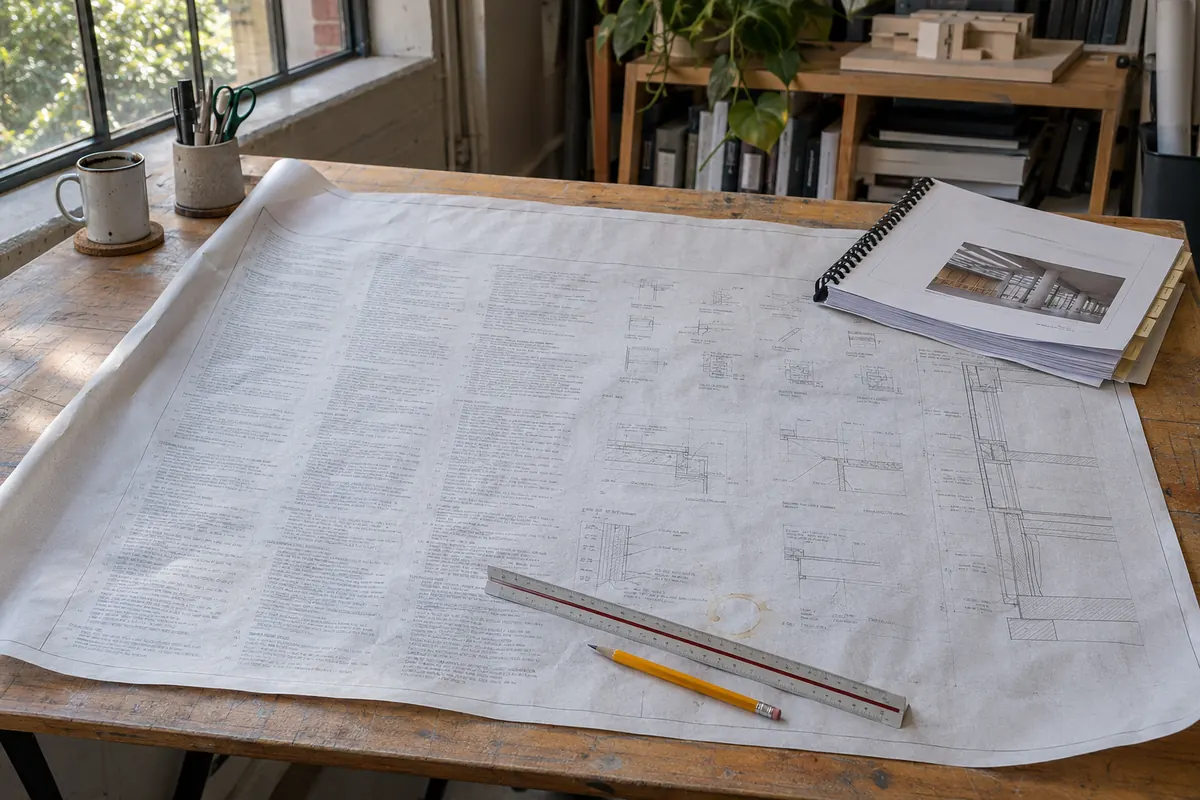
The specs complement the drawings. Depending on the contract, they can also take precedence over other documents, so always check the order of precedence in the conditions of contract. Besides the technical sections, a project manual usually holds procurement material: bid forms, conditions of contract, supplementary conditions, insurance and bond requirements. Text is the main tool, but a sketch or diagram belongs in a spec wherever words alone would likely be misread.
What a specification writer does
The writer's core job is translation. Drawings, schedules and tables become written instructions to the contractor, section by section. To do that well, a spec writer needs real construction knowledge, field experience, patient research habits, a working grasp of codes and standards, and a very organized way of working.
In practice, a spec writer acts as the bridge between the design team and the builder. Much of the work is gathering and checking manufacturer information: product data, standards the products meet, installation requirements, warranties. On request, the writer can also produce an as-built version of the specification that records what was actually constructed.
Spec writers tend to specialize in a type of document, not in a trade. One writer may produce sections for 20 or more areas of practice, from roofing to door hardware, and few people have deep hands-on experience in all of them. That is why complex or customized systems, such as the building envelope, fire protection, door hardware and mechanical systems, are often better specified by a specialist in that field, with the spec writer coordinating format and cross-references. Our guide to what MEP works mean covers the engineering scopes that usually come with their own sections.
In-house, freelance or a specification firm
Who writes the specs usually depends on the size of the design firm:
- Firms under about 15 people: a principal or senior architect coordinates directly with an independent specifier.
- Mid-size firms: often employ one full-time specification writer.
- Large firms: may run a whole specifications department.
- Any firm, at any time: can bring in an independent writer for a particular project or to cover a peak.
Specification writing is a shrinking specialty, and many offices end up with architects and technicians writing specs on top of their design work. That tends to cause problems at every stage, from product selection to bidding. Writers themselves often cite time management as their biggest difficulty, which fits what offices see when spec work is squeezed in at the end.
Design firms delegate spec work for three common reasons. It spreads design responsibility and risk. It brings in a specialist's precision with contract language. And it keeps up with aggressive design schedules that leave the project team no time to write. An architectural designer or project architect stays responsible for design intent, while the outside writer handles the written documents.
When to bring a spec writer into the project
How early to involve a writer depends on the size and complexity of the project, how many innovative or specialized products it uses, and how much research those products need. A clinic with custom curtain wall needs the writer sooner than a simple warehouse.
The practical deadline is when working drawings are about 40 percent complete and the main materials have been chosen. Earlier is better: a writer brought in at schematic design can produce outline specifications and project descriptions that help the owner and cost consultant before details are fixed. On projects pursuing LEED certification, bring the specifier in right after the team has decided which LEED points to go after, since those choices drive many sections.
The failure pattern is familiar. The writer gets a call the week before the bid set goes out, works 18-hour days, and nobody has time to coordinate. The specs are issued late as an addendum, and a low bidder recovers the gaps through change orders once the contract is signed.
What the service covers: Division 00, Division 01 and technical sections
In the USA and Canada, specifications are organized with CSI MasterFormat, which arranges the work into 50 divisions. Every technical section follows the same three parts: Part 1 General, Part 2 Products, Part 3 Execution.
Division 00: procurement and contracting
Division 00 uses MasterFormat numbering, but strictly speaking it is not a specification. It has three groups: introductory information, procurement requirements and contracting requirements. Because it carries legal weight, it is prepared with the owner's legal counsel and insurance and surety advisers. Most government agencies supply their own Division 00.
When a firm's own Divisions 01 to 49 are combined with an owner's Division 00 without coordination, gaps in the contract requirements appear. Duplicated or conflicting clauses are worse: a court or arbitrator may enforce only the less strict version, or throw the clauses out and impose its own reading. Purchased or third-party specs always need editing to fit the project's Division 00.
Division 01: general requirements
Division 01 sets the rules that apply to every trade. It covers the summary of work, price and payment procedures, administrative requirements, quality requirements, temporary facilities, product requirements, execution and closeout, and life cycle activities.
| Section | What it controls |
|---|---|
| 01 21 00, 01 22 00, 01 23 00 | Allowances, unit prices and alternates; must match the bid form and the technical sections they affect |
| 01 25 00 | Substitution procedures |
| 01 26 00 | RFIs and change orders |
| 01 33 00 | Submittals |
| 01 40 00 | Quality assurance and control, mockups, testing |
| 01 74 20 | Construction waste management |
| 01 77 00 | Closeout: O&M manuals, warranties, record drawings |
| 01 91 00 | Commissioning |
Unit prices suit work whose quantities cannot be known at bid time. The sustainability sections, waste management and commissioning, should line up with LEED requirements when the project is pursuing certification.
Prescriptive, performance and proprietary specs
Within the technical sections, the writer picks a method for each product, based on how complex it is and what result the designer wants.
- Prescriptive: describes the product and cites standards, for example 5/8 inch Type X gypsum board fastened with screws at a set spacing.
- Performance: states the required result and the standard to measure it by, for example attic insulation reaching R-38.
- Proprietary: names manufacturers and models, for example a specific brand of occupancy sensors.
US specs also cite the codes and standards the work must meet: IBC, NEC, IPC and IMC, energy standards such as ASHRAE 90.1 and the IECC, and state rules that differ from the model codes, such as California's Title 24 energy requirements.
What to prepare and how reviews work
A spec writer can only write what the design team has decided. The handover goes much better when the architect provides the following.
- A primary project description written during schematic design.
- A folder of catalogue cuts, web pages and notes, sorted by MasterFormat division.
- One- to two-page design narratives for each section before drafting starts, with key product literature attached, for example for windows and mechanical equipment.
- An invitation to design meetings, including the ones where late changes are made. Remote attendance works fine.
Reviews should run in steps: the narratives first, then a review during design development, another at construction documents, and a final check before issue. Inside the office, a reviewer proofreads and coordinates the specs at 60 percent, 90 percent and before issue. Leave time in the schedule for revisions and meetings. If the review budget is tight, several short reviews work better than one exhaustive one, which tends to produce confused markups.
One US team that avoided major change orders in preconstruction held day-long coordination meetings, had each consultant draft its own sections, reviewed face to face, and re-proofed every time the design changed. Another useful step is asking bidders to sign a letter reporting any conflicts they found during pre-bid review. It will not stop disputes, but it pushes everyone toward coordination before prices are fixed.
Spec writing mistakes that cost money
Bidders read the specs closely. When they sense gaps, they add contingency to the price, and poorly coordinated documents lead to change orders, claims and disputes later. Construction managers often build bid packages from spec sections instead of drawings, so a spec that disagrees with the drawings makes it hard to buy the materials that were actually drawn.
Small wording choices swing cost. In one set of US examples, adhered roofing ran about 7 USD per square foot against 15 USD for a mechanically fastened system, and a zinc brick tie about 3 USD against 6 USD for a stainless adjustable anchor. Prices have moved since, but the point holds: the spec decides which one gets priced.
Typical failures from real projects:
- Generic "canned" specs that clashed with the drawings, with outdated product designations and discontinued materials, ending in large change orders.
- An in-house writer who did not know about the design team's research specified the wrong flashing membrane at several hundred windows. The owner had to choose between a weaker product and a 50,000 USD change order.
- A vague window spec on a school let the contractor swap the intended prefabricated units for a field-assembled system, and poor installation followed.
- A writer hired the week before issue, with specs going out as an addendum.
Accurate specs also feed cost planning. If you are pricing early, a building cost estimator gives a rough budget, but the bids themselves will follow what the specification says.
How to judge spec quality and choose a provider
A good specification is often summed up by the five Cs: clear, consistent, complete, correct and coordinated. Ask for sample sections and read them against these points.
- Language is short, specific and imperative, with the same term used for the same thing throughout.
- No "as required", "as needed" or "or equivalent". The text addresses the contractor and never names a particular trade.
- Tables and schedules are used wherever they are clearer than prose.
- Precise wording. "Good quality flooring" says nothing; a named tile size, slip resistance (COF), grout type and TCNA installation method can be priced and checked.
- Balance. Overspecifying limits the contractor and raises cost, while underspecifying invites misunderstanding. Naming acceptable manufacturers and allowing only a proven equal is a common middle ground.
Ask how the provider maintains its master specification. A solid one compiles the common sections, standardizes language, is reviewed every year, has a named owner and is kept under version control. Old project specs should never be reused without revision, however similar the projects look, and references to standards need updating yearly. Manufacturer data should be verified, the architect or engineer should review the finished spec, and some writers ask manufacturers to check their typical sections from time to time.
Fees are quoted per project, and scope drives the quote: project size, number of sections, which specialist sections consultants write themselves, and how many review rounds you want. Spec fees sit inside the wider design budget, covered in our guide on how much an architect costs. Newer services also link specs to BIM models or use AI-assisted drafting, and some address circular economy requirements, but every section still needs a person who knows the project to check it.
Specification writing FAQ
When should a spec writer join a project?
At the latest when working drawings are about 40 percent done and the main materials are chosen. Earlier is better, at schematic design, so the writer can produce outline specs. On LEED projects, right after the team picks the LEED points to pursue.
Do small projects need a project manual?
Not always. Notes on the drawings can be enough for small and sometimes medium projects. Larger ones usually need a separate project manual because the sheets run out of space.
What is Division 00 and who writes it?
Division 00 holds the procurement and contracting requirements: introductory information, procurement requirements and contracting requirements. It carries legal weight, so it is prepared with the owner's legal counsel, insurance and surety advisers. Most government agencies issue their own, and the spec writer must coordinate the other divisions with it.
What is the difference between prescriptive, performance and proprietary specs?
Prescriptive specs describe the product and cite standards. Performance specs state the result to be achieved and the standard to test it against. Proprietary specs name the manufacturer and model. The choice depends on the product's complexity and the result the designer needs.
Can I reuse a spec from a previous project?
Only after a full revision. Recycled specs carry outdated product names, discontinued materials and old standard references, and they clash with the new drawings. Even projects that look alike need edited sections.
Who coordinates specs with the drawings?
The spec writer and the design team together. The architect supplies narratives and product information and invites the writer to design meetings, and an office reviewer checks the specs against the drawings at 60 percent, 90 percent and before issue.
 MEP works means mechanical, electrical and plumbing: what the scope covers
 Architectural designer: what they do and how they differ from an architect
 Building Cost Estimator: How to Get a House Construction Cost Estimate