Article furniture design: the brand, the process and what a furniture designer checks
Article is a direct-to-consumer modern furniture brand from Vancouver, Canada, known for mid-century and Scandinavian pieces sold mostly online. Below is how the brand works, what it costs in the US, and the furniture design principles (ergonomics, standard dimensions, bracing, materials) that decide whether any piece is comfortable and lasts.
- Topic
- Furniture design
- Updated
- Reading time
- 12 min
- Studio
- Morales Arch & Design
In this article
- What "Article furniture design" means
- How the brand designs and makes its furniture
- Style range: mid-century modern and Scandinavian furniture design
- The furniture design process: brief, ergonomics, dimensions, prototype
- Structure, joinery and materials
- Storage, multifunction pieces and small-space design
- Article furniture prices in the US
- Delivery, assembly and buying tips
- What a furniture designer does and when custom design makes sense
- Article furniture FAQ
What "Article furniture design" means
The phrase covers two things people search for. One is Article, a direct-to-consumer furniture and decor company from Vancouver, Canada, that has been selling modern pieces for more than ten years. The other is furniture design as a discipline: how a chair, table or bed gets its size, shape, structure and materials.
Article was started in 2013 by four friends with engineering backgrounds. It traded as Bryght at first and took the name Article in 2016. The company sells mainly online, which helps keep its prices below those of many showroom-based retailers.
Both sides are covered here. If you are comparing a sofa online, the first half helps. If you want to know what makes furniture comfortable and durable, or you are thinking about a custom piece, the second half covers the design rules a furniture designer works with.
How the brand designs and makes its furniture
Article's designs are drafted in Vancouver. Production happens at partner factories in several countries, and the finished pieces ship straight to the customer rather than through a chain of stores. That model is typical for direct-to-consumer furniture: the design team controls the look, and the factory handles volume.
The brand does keep a few showrooms where you can sit on a sofa before buying. As of 2026 they are in Vancouver, Toronto and the San Francisco Design District. Everything else is ordered online, so most buyers judge a piece from photos, dimensions and reviews.
Because so much depends on the spec sheet, it pays to read the listed seat height, depth and overall size against the ergonomic numbers further down this page.
Style range: mid-century modern and Scandinavian furniture design
The core look is mid-century modern: low profiles, tapered legs, walnut and oak, clean upholstery. Around that sit Scandinavian, boho and coastal lines. One sofa with a low 1970s-style profile comes in six colors, and the dining chairs are offered with several seat colors on the same walnut frame.
A practical point is that pieces are drawn to coordinate across rooms. You can furnish a living room, dining room and bedroom from the same range and the result reads as one home. Design teaching describes harmony as unity plus variety, and matched sets such as bedroom suites are the easiest route to it. The risk is a showroom feel, so many people mix in one or two older or handmade pieces.
Leg shape does a lot of the visual work. A dining table on long tapered legs looks lighter than one on chunky square legs, even when the top is the same size. If you like a calm, pared-back look, the same logic carries into a japandi interior.
The furniture design process: brief, ergonomics, dimensions, prototype
Every piece starts with a brief. A designer asks what the piece is for, who will use it, where it will stand, how big it can be, what style it belongs to, whether it should be a focal point or blend in, and whether its contents should be hidden or on show.
Ergonomics comes next, and it has to come early. Fitting the product to the person is what makes it safe, comfortable and easy to use, and it is hard to fix once the frame is drawn. Anthropometric data (body sizes, reach, strength, mobility and posture) sets the starting size and shape. Furniture is usually scaled to the average adult so that a short person can reach and a tall person fits; people at the extremes are better served by custom pieces. Comfort norms also differ between cultures, for example where people habitually squat.
General guidelines for seating and work surfaces:
- The user faces the task and can sit upright.
- Joints stay near the middle of their range, with hands below shoulder height.
- Feet rest flat on the floor and knees do not rise above the thigh.
- Armrests support the forearms without pushing the shoulders up.
- A seat that is too deep presses behind the knees and makes you slouch; a seat that is too shallow feels unstable.
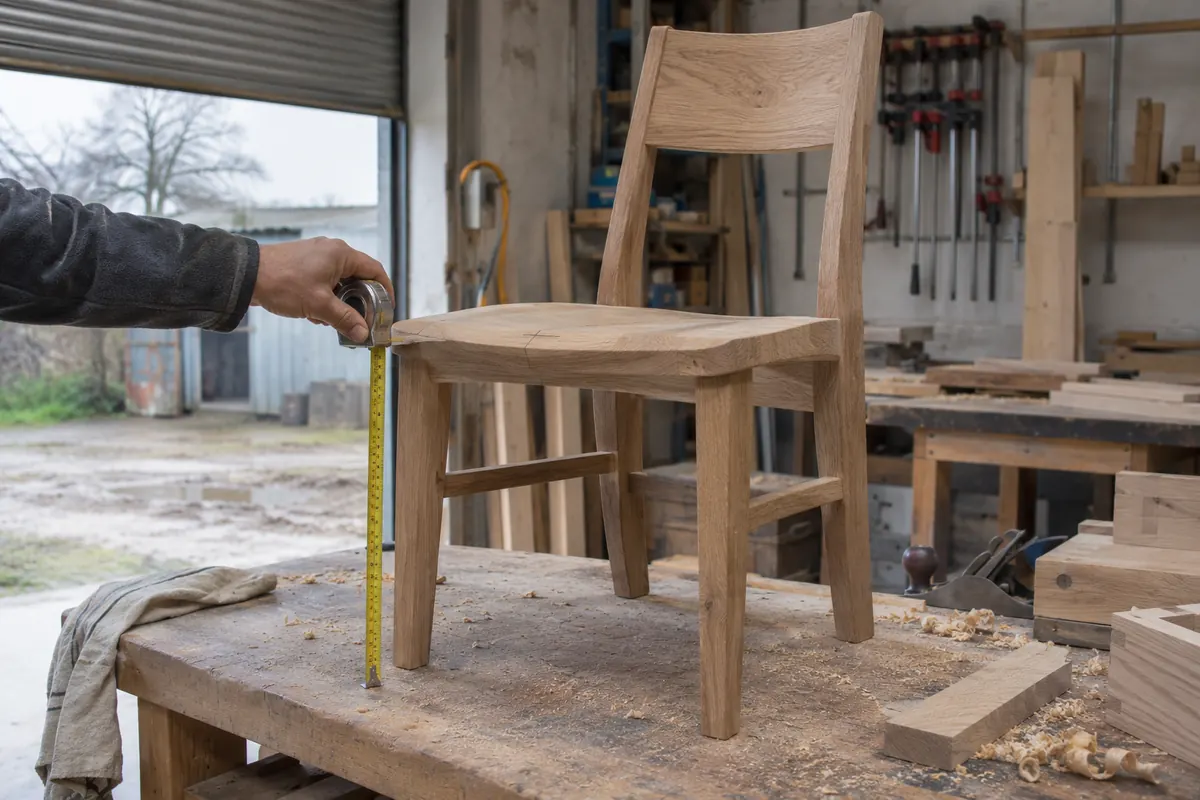
Typical chair dimensions for average-sized adults are a useful start:
| Measurement | Metric | Inches |
|---|---|---|
| Seat width | 405-508 mm | about 16-20 in |
| Seat depth | 380-460 mm | about 15-18 in |
| Seat height, general | 405-460 mm | about 16-18 in |
| Armrest above seat | 178-203 mm | about 7-8 in |
| Dining chair seat height | 406-432 mm | 16-17 in |
| Easy chair seat height | about 406 mm | about 16 in |
| Easy chair back above seat | no more than 356-406 mm | about 14-16 in |
Seat slope changes with use. Lounge chairs tilt back about 8-15 degrees, dining chairs about 2-5 degrees, and office chairs are often flat. A dining chair back should recline no more than 5 degrees, and its armrests must clear the table apron. An easy chair works with a seat angled about 10 degrees and a seat-to-back angle of 95-120 degrees.
These figures are starting points. For a custom chair, design around the actual user, and measure a chair you already find comfortable. Digital tools help here: human-model software checks seat measurements, 3D seat shapes can be flattened into fabric patterns, and finite element analysis tests a frame before it is built. After the materials are chosen, a physical prototype shows what the drawings missed.
Structure, joinery and materials
Good furniture is a small structure. Forces have to stay in balance, or cantilevers fail, shelves sag and pieces tip. Joints must resist lateral, shear and rotational forces. A rocking chair adds dynamic loads, so it needs bracing, and its tilt point must sit under the combined center of gravity of chair and sitter. Tall, narrow cabinets may need anchoring to the wall or floor, and long shelf spans will deflect unless they are supported.
The common ways to stabilize a frame:
- Three legs. A three-legged stool or small table never wobbles, even if the legs are slightly different lengths.
- Cross-bracing. X diagonals resist sideways racking on chairs and bookshelves.
- Corner blocks. Small blocks glued into corners stiffen joints.
- Stretchers. Rails between legs spread load and stop splay.
- Aprons. Rails linking the legs to the tabletop carry load and tie the frame together.
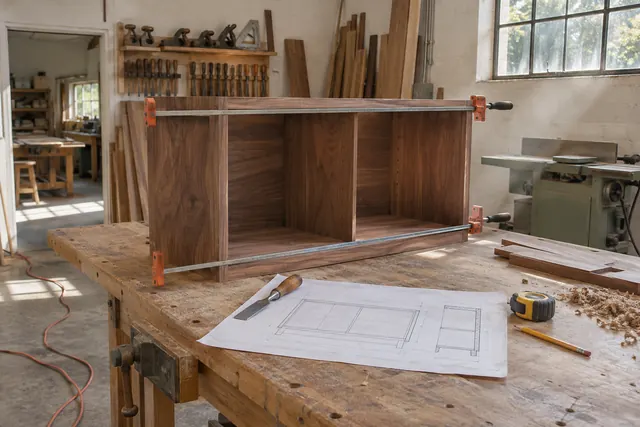
Joint choice depends on the job, and precise, well-chosen joints are what let a piece last for decades. Detail like this is usually settled in furniture detail drawings before anything is cut.
Material follows function. Hardwoods suit parts that take shock and abrasion; white oak and ash steam-bend without cracking. Chair legs need hard, splinter-resistant timber such as maple, while seats can use softer pine or poplar that is easy to shape. Outdoor pieces need weather-resistant species such as cypress or jarrah. Almost any species can work if the design allows for its weak points. Material can also lead the design: Arne Jacobsen's 3107 chair of 1955 is built around formed plywood.
Upholstery choices matter as much. Performance velvet resists fading and cleans easily, leather is a common pick for homes with pets, and some sofas with down pillows are spot-clean only. A slipcover option makes a light fabric more practical.
On sustainability, responsibly sourced wood stores carbon, up to about half of its dry weight. Recycled and local timber cut emissions further, and furniture built to last works against the short life of cheap flat-pack and the waste it creates.
Storage, multifunction pieces and small-space design
A lot of modern furniture design is about doing more in less floor area. Examples from the brand's recent range show the main moves:
- A queen storage bed with four 21.75-inch soft-close drawers can replace a dresser.
- A lift-top coffee table doubles as a desk or an eating surface; another coffee table hides storage inside.
- A 35-inch storage ottoman has a flip lid that turns into a tray.
- A 36-inch bar cabinet holds about eight bottles or can serve as a coffee station.
- A 44-inch kitchen island with open shelves, two drawers and a quartz top fits two stools in a small kitchen.
- A low 63-inch solid wood media unit keeps the TV at eye level for someone seated.
- A molded-plastic dining chair stacks and can go outdoors.
- A narrow 79-inch sofa with foam-and-fiber cushions suits small living rooms.
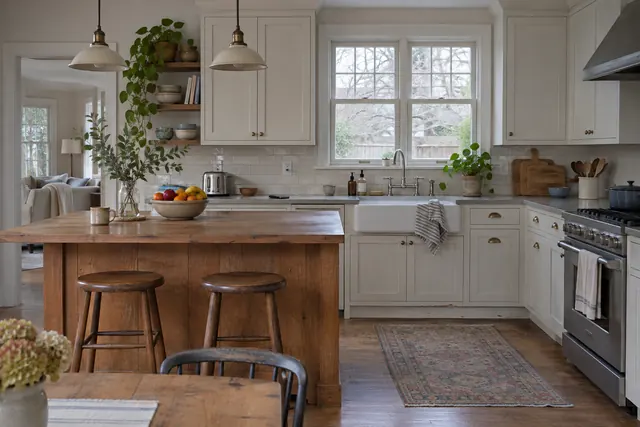
Safety is part of the same thinking. A side table with a rounded shape looks softer and is safer around small children than one with sharp corners. For kitchens built around storage and circulation, see our notes on kitchen design.
Article furniture prices in the US
Full-price sofas run from about $699 to $4,799 in the US in 2026. The table shows typical list prices by piece and the year each price was listed.
| Piece | Price | Year |
|---|---|---|
| 79-inch narrow sofa | from $799 | 2026 |
| 90-inch performance velvet sofa | $1,399 | 2026 |
| 71.5-inch loveseat, performance fabric | $1,299 | 2026 |
| 72-inch tufted leather loveseat | $1,599 | 2026 |
| Leather sofa | $1,999 | 2024 |
| Low-profile loveseat / three-seater | $949 / $1,149 | 2024 |
| Sofa shipped in two pieces | $1,399 | 2024 |
| Dining table, walnut or oak (2-3 seats to 8+) | $469-$1,299 | 2024 |
| Walnut dining chair, padded | $139 | 2024 |
| Stackable plastic dining chair | $79 | 2026 |
| Queen storage bed | $2,199 | 2026 |
| Storage coffee table / lift-top coffee table | $699 / $599 | 2026 |
| Storage ottoman | $449 | 2026 |
| Bar cabinet | $899 | 2026 |
| Kitchen island | $1,199 | 2026 |
| 63-inch media unit | $899 | 2024 |
One long-term reviewer reports that the tufted leather loveseat has held up well over several years of use, which is the real test of value at these prices.
Delivery, assembly and buying tips
In 2026, US delivery to the door costs $59 within the service area, and items under $200 go by courier for $19. White Glove delivery adds assembly. If you assemble yourself, most pieces take under an hour. Policies listed in 2024 were free delivery on orders over $999, a 30-day satisfaction guarantee, free exchanges and a one-year warranty.
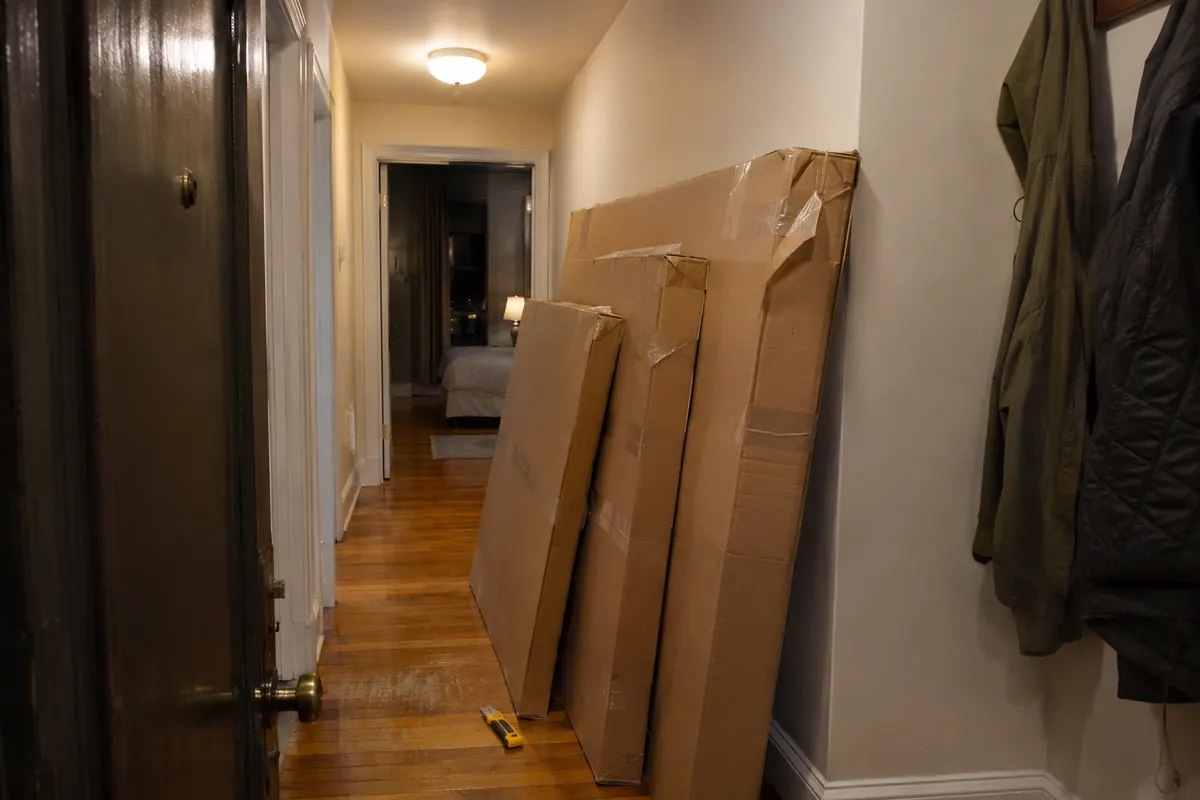
Measure every doorway, hallway and stair turn before ordering. A piece has to pass through both in its box and once assembled. This is why some sofas ship in two pieces for apartments.
Timing helps too. Sales tend to fall around Black Friday, Cyber Monday, Memorial Day and Labor Day.
What a furniture designer does and when custom design makes sense
The way a chair goes from idea to product has changed a lot. Until the 19th century, chairs were mostly regional craft, such as the English Windsor chair. Over the 19th and 20th centuries they became the work of named designers and factories. A furniture designer today still faces the same trade-offs: comfortable but good-looking, good-looking but strong, strong but light. Everything starts from ergonomics, then structure and material, then a prototype. A design chair can even be a classic reworked in new materials.
Catalog pieces cover most homes. Custom design earns its place when standard sizes do not fit the user or the room, or when nothing on the market exists, for example a long upholstered bench running the length of a restaurant. Such pieces give a space a look nobody else has. Our page on furniture design services explains how that work is organised.
Commercial projects work differently from homes. The actual users are unknown, so the designer works from a target-user profile, and the client's priorities set the comfort level. Offices and labs often use systems furniture: modules that can be reconfigured and carry wiring. Finishes need to survive heavy use, so patterns, light texture and mid-to-dark colors hide dirt and scratches, and every material must tolerate cleaning detergents. A commercial interior designer usually coordinates these choices with the rest of the fit-out.
Article furniture FAQ
Does Article have stores?
It is mainly an online retailer, but in 2026 it has showrooms in Vancouver, Toronto and the San Francisco Design District.
Is Article furniture worth it?
For mid-century and Scandinavian styling at online prices it is a reasonable option. Check seat dimensions, fabric care and delivery access before buying, and compare against the ergonomic ranges above.
Is Article furniture easy to assemble?
Most pieces take under an hour to put together yourself. White Glove delivery includes assembly if you prefer not to.
Does Article have sales?
Discounts usually come around Black Friday, Cyber Monday, Memorial Day and Labor Day.
How much does Article delivery cost?
In the US in 2026, door delivery is $59 within the service area and items under $200 ship by courier for $19. In 2024 orders over $999 shipped free.
What dimensions should a dining chair have?
A seat height of 406-432 mm (16-17 in), a back reclined no more than 5 degrees, a seat slope of about 2-5 degrees, and armrests low enough to clear the table apron.
 Japandi Interior: How to Put the Style Together Room by Room
 Furniture Detail Drawings: Views, Joinery and What the Shop Needs
 Kitchen Design: A Practical Guide to Designing the Kitchen