Bedroom style ideas: 12 looks, from modern to boho
The bedroom styles worth comparing first are modern, minimalist, Scandinavian, Japandi, farmhouse, rustic, vintage, French, boho, coastal, soft romantic and cozy. Pick the one that matches how you live, limit yourself to two or three main colors, and decorate outward from the bed. Scale, light and texture then decide how well the room works.
- Topic
- Interior styles
- Updated
- Reading time
- 11 min
- Studio
- Morales Arch & Design
In this article
- How to choose a bedroom style idea that suits you
- Modern, contemporary and minimalist bedrooms
- Scandinavian and Japandi bedroom style ideas
- Farmhouse, rustic, vintage and French bedrooms
- Boho and coastal bedrooms
- Soft romantic and cozy bedrooms
- Bedroom colors, feature walls and bedding
- Bed placement, lighting, rugs and curtains
- Small bedroom ideas and storage
- Finishing touches and common mistakes
- Bedroom design questions
How to choose a bedroom style idea that suits you
Start with habits. People who love the outdoors usually settle into rustic or boho, while anyone who prefers order and quiet tends to be happier with minimalist or modern. Hobbies and favorite colors are useful clues as well. Daylight, floor area and budget narrow the choice further.
The table compares the main looks by what you would actually buy and paint.
| Style | Colors | Materials and furniture | Defining detail |
|---|---|---|---|
| Modern | White, gray, black; brown and tan | Metal, glass, upholstered headboard | Only pieces with a purpose |
| Minimalist | A simple palette | Warm wood, soft fabric | Clear surfaces, one or two statement pieces |
| Scandinavian | Pale, natural tones | Natural elements | Clean lines |
| Japandi | Soft colors | Light wood, linen | Low bed and open floor |
| Farmhouse | Neutrals, pastels | Weathered wood, stone, linen | Vintage-inspired lighting |
| Rustic | Natural wood tones | Wood | Mixes with industrial or minimalist pieces |
| Vintage | Pale colors | Iron bed, second-hand finds | Sheers hung on the bed frame |
| French | Pastels | Satin, curved-leg furniture | French windows where possible |
| Boho | Vibrant colors, ethnic patterns | Rattan, macrame, mixed finishes | Layered or vintage rugs |
| Coastal | Blue, white, sandy yellow | Cotton, wicker, wood | Shells and sea artwork |
| Soft romantic | One pale color in many shades | Sheers, velvet, boucle | Canopy and warm light |
| Cozy | Any restful palette | High-quality bedding | Hotel-like romantic lighting |
Labels are only a starting point. Old and new furniture can share a room, provided a few finishes repeat. The direction for 2027 is back to nature, with wood and bamboo throughout and the bedroom treated as a sanctuary.
Modern, contemporary and minimalist bedrooms
A modern bedroom keeps only furniture that does a job, and the bed stays the main piece. White, gray and black with metal and glass is the cooler version; brown, tan and white feels warmer. Add color in bold bursts through a cushion, a plant or one simple abstract canvas. Accessories stay few. Light window treatments, or none at all where privacy allows, let the daylight in.
Contemporary rooms take more liberties. Platform beds come in unusual shapes or seem to levitate over ambient lighting, and a large window with a good view becomes part of the design. In a big, sparse room a small fixture gets lost, so hang a statement pendant or a pair. A minimalist chandelier or spotlights suit ordinary proportions.
Bright accents need a decision about intensity. Jewel tones read as luxurious and dusty brights as understated, while neon works only in small doses.
Minimalist rooms use fewer objects still, a simple palette and bare surfaces. The risk is a cold result. Warm wood and soft textiles prevent it, along with one or two pieces that carry some character.
Scandinavian and Japandi bedroom style ideas
Scandinavian bedrooms rely on clean lines and natural elements. Our guide to the Scandinavian interior covers the approach for the rest of the home.
Japandi lowers everything. Choose a low-profile bed in light wood, linen bedding and soft colors, with very little other furniture. Open space is part of the composition, so resist filling the empty corner.
Both styles depend on materials you can feel, such as wood, rattan baskets, linen, stone and woven shades. Plants belong here too, and good faux greenery is a fair substitute where daylight is poor. For the same idea applied to other rooms, see the article on the Japandi interior.
Farmhouse, rustic, vintage and French bedrooms
Farmhouse stays fresh when it is kept simple. A wood bed, neutral bedding, cozy textiles and a vintage-inspired light fixture are enough, and a few newer pieces keep it from looking like a set. For a fuller country version, bring in stone, brick or wood veneer walls, floral and checked fabrics, pastels, and a lace or embroidered bedspread. The look sits comfortably in a ranch style house.
Rustic is flexible. Pair timber with industrial metal, or strip the room back and let one wood surface stand against a minimalist scheme.
For a vintage bedroom, look for an iron bed and drape sheer curtains over its frame. Pale walls and second-hand finds complete it. French bedrooms are dressier, with pastels, satin, furniture on curved legs and, if the architecture allows, French windows.
Boho and coastal bedrooms
Boho is the most spontaneous style on the list. Wood finishes need not match. Layer rich rugs, hang macrame, use printed textiles with ethnic or floral patterns, then add plants and a handmade or bamboo light. A woven headboard or one good vintage rug can set the tone before anything else arrives. Vintage furniture and feathered accessories fit the mood.
Coastal bedrooms work with blue, white and sandy yellow. Cotton sheets, wicker and wood provide the base; a sea painting and a small group of shells finish it.
Soft romantic and cozy bedrooms
Pale colors, sheer fabrics and warm light create the dreamy version of a bedroom. One pastel taken through many shades works well as long as texture changes from surface to surface. On the walls, pearlescent clay paint goes on thinly, in two coats for depth.
A slim canopy frame mounted to the ceiling, in white or pale oak with sheer fabric, adds height without heavy posts. If you prefer something lower, a platform bed with a frame padded in linen or velvet calms the room and makes a small one feel wider. A boucle bench fits at the foot and a velvet swivel chair in the corner.
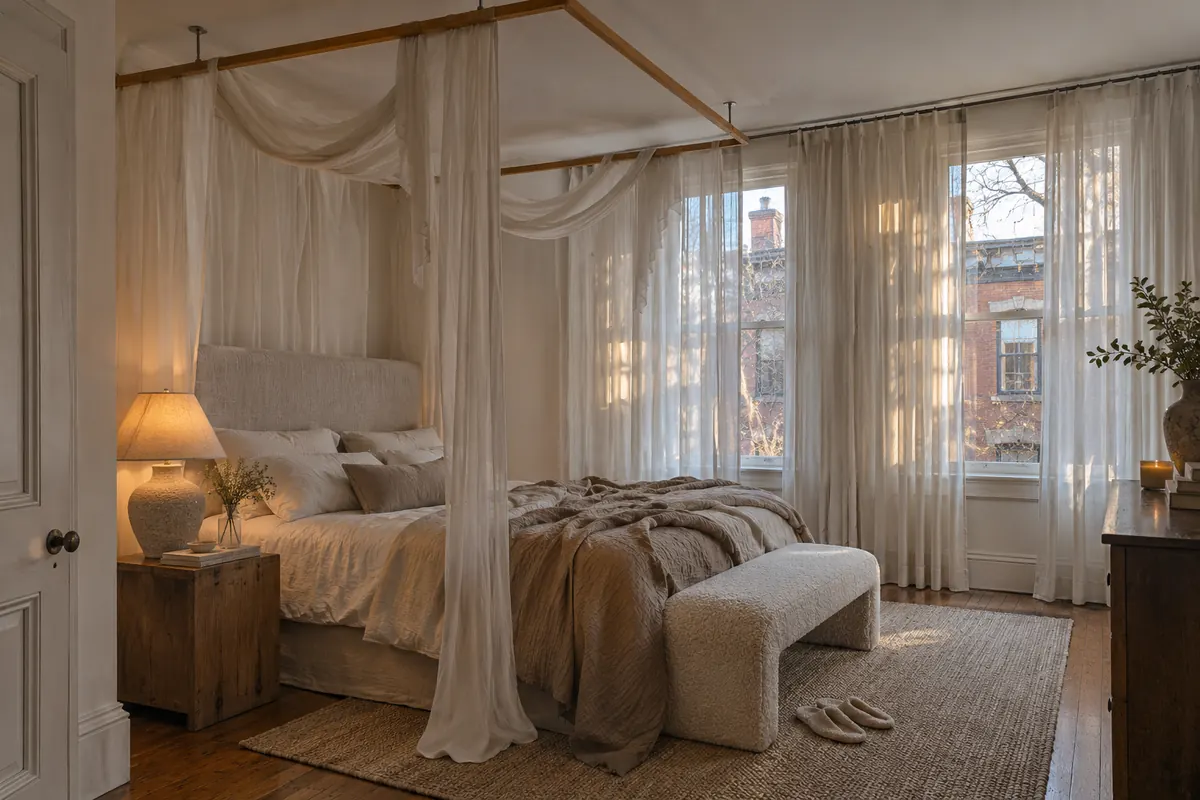
Hide part of the lighting. Cove LED strips tucked into crown molding and put on a dimmer give an evening glow without glare. Brushed brass hardware is a good match for pale wood, and low-contrast art keeps the mood quiet. A ceiling medallion or a scent diffuser can finish the scene.
Cozy bedrooms borrow from hotels: excellent bedding and romantic lamplight.
Bedroom colors, feature walls and bedding
Palette
Choose two or three main colors and repeat them in the bedding, curtains, rug and art. Every later purchase becomes easier. Warm white, beige, taupe, green, navy and natural wood tones are easy to live with. Color influences mood and sleep quality too: pastels relax, vivid hues energize, light tones open up a small room. Neutrals soothe, with interest supplied by lighting, framed art, nightstands and the rug.
Deep green, navy, brown and charcoal turn the room dramatic. They need rich surfaces such as satin or metal, otherwise they look flat. Navy pairs well with cream, white, wood and brass.
The wall behind the bed
Paint is the simplest feature wall, in black, muted green, gray or another contrasting color, and a dark one makes a light headboard stand out. Wallpaper, molding, board and batten, paneling and wood slats are alternatives. Fluted trim painted to match the wall gives depth without contrast, while reclaimed wood can double as the headboard.
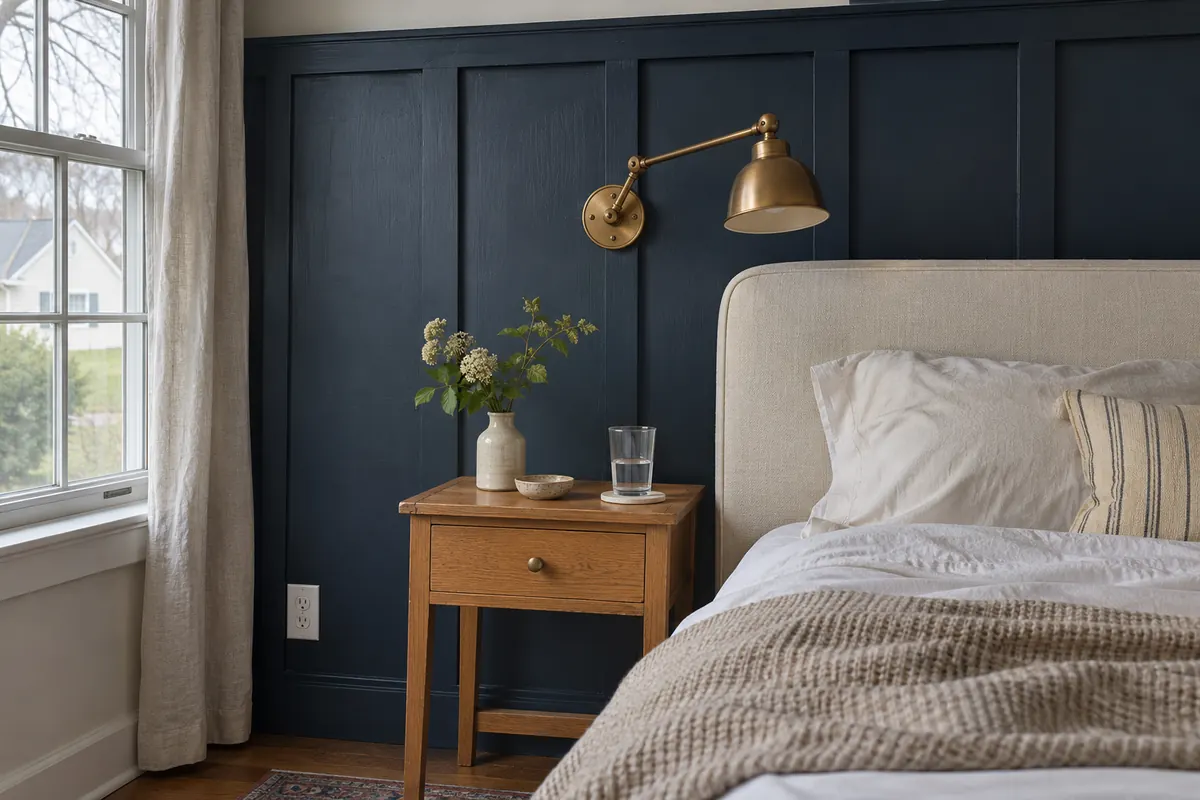
You can also replace the headboard with a full wall of niche shelves, a backlit niche or storage behind the bed. For art, one large piece scaled to the bed width is easier to get right than a gallery wall. Choose something restful, and simpler still if the room is already busy.
Bedding and texture
Build the bed in layers: sheets, duvet, a quilt or coverlet (a diamond weave is one option), a folded blanket at the foot and a few pillows. Mix cotton with linen, knit or velvet, then stop before it looks overdone. Neutral rooms gain more from a chunky throw, boucle, woven shades or a textured rug than from extra ornaments.
Bed placement, lighting, rugs and curtains
Fix the bed position first, since it is the largest object and the natural focal point. The wardrobe usually goes on the longest wall, and nightstands sit at equal distances from the bed. In an awkward room the bed can stand in front of a window if the headboard is low, the frame simple and the curtains wider than usual.
- Lighting. A single ceiling fixture flattens the room. Combine it with bedside and floor lamps, sconces or reading lights, and choose warm bulbs over cool white. Sconces mounted as a pair keep the wall symmetrical and free up the nightstand. Match the fixtures to the room style.
- Rug. It should extend past both sides of the bed. Too small is the most common mistake. Small rooms take lighter rugs with a small pattern; large rooms can carry darker, bigger motifs. Wool feels warm underfoot, and a rug can lie over carpet.
- Curtains. Mount the rod several inches above the frame and wider than the window, with long panels. Blackout fabric improves sleep; tulle or roller blinds control daylight. Use light tulle in small rooms and long heavy drapes on large windows. Double sheers on a ceiling track give privacy and soft daylight together.
- Flooring. Carpet, wood parquet and laminate all work, depending on lifestyle and budget.
Nightstands need a lamp, one or two small items and some free surface. The two sides should feel balanced, although they need not be identical. If the room is large, add a reading chair, an ottoman, a sitting corner or a dressing area.
Small bedroom ideas and storage
Scale the furniture down first. Narrow or floating nightstands, a smaller dresser and wall-mounted lights recover floor area at once. On a floating nightstand, one lamp and one book is plenty. Folding beds, storage beds and multipurpose furniture add function without adding pieces.
Keep colors light and daylight as open as possible. One large mirror beats several small ones: stand a full-length mirror near the window, lean an arched one against the wall, or hang it opposite the window so it doubles the daylight. Curtains hung high help too.
- Use drawers under the bed, shelves behind the headboard, wall shelves and hanging cabinets.
- Run wardrobes floor to ceiling with flat doors in the wall color; they almost disappear.
- Fit pocket doors to save swing space or hide a TV.
- Make a vanity from a narrow desk or console with a mirror and stool, ideally by a window. A floating shelf does the same job in less room.
- Personalize with photos and a few keepsakes.
Finishing touches and common mistakes
Scale and clutter cause most of the trouble in a bedroom. Before buying another accessory, check the following.
- The rug shows on both sides of the bed.
- Light comes from several points, and the bulbs are warm.
- One metal or wood finish repeats across the room.
- The dresser has a large mirror and a few bigger objects at different heights, instead of many small ones.
- Art is sized to the bed.
- Some wall and floor remain deliberately empty.
Guest bedrooms deserve the same restraint and look best kept simple. If the project grows into new lighting positions, built-in wardrobes or pocket doors, it helps to know what an interior designer does before you start ordering.
Bedroom design questions
What are the most popular bedroom styles?
Modern, farmhouse, coastal, boho and Scandinavian come up again and again, along with Japandi, minimalist, rustic, vintage and French. Cozy, hotel-inspired lighting and bedding can be added to any of them.
What colors suit a bedroom?
Warm white, beige, taupe, green, navy and wood tones are dependable. Pastels help you relax. Use light shades to enlarge a small room and deep ones for drama, supported by rich textures.
How big should a bedroom rug be?
Large enough to extend beyond both sides of the bed. When in doubt go larger, because buying one too small is the most common mistake.
How high should curtains hang?
Set the rod several inches above the window frame and let it run wider than the opening, so the window looks larger. Floor-to-ceiling sheers can hang from a ceiling track.
How do you make a small bedroom look bigger?
Choose light colors, a low platform bed, floating nightstands and wall lights. Place one large mirror near or opposite the window, and paint wardrobe doors the wall color.
How should a bedroom be lit?
Use a ceiling fixture together with bedside lamps or sconces, plus a floor or reading lamp. Keep the light dim and warm, with a dimmer on any cove lighting.
How do you decorate a bedroom on a budget?
Begin with paint on the wall behind the bed, then layer bedding from a short palette. Second-hand pieces suit vintage and boho rooms, and one large artwork or mirror can do the work of many small purchases. A floating shelf can stand in for a vanity.
 Scandinavian interior: how the style works, room by room
 Japandi Interior: How to Put the Style Together Room by Room
 Ranch Style House: Features, Types, Floor Plans and Modern Ideas